Acquisition

Honorable Steve Feinberg, Deputy Secretary of War. (DOW photo)
Three initiatives causing industry new concerns about DoD acquisition reforms
Jason Miller, Federal News Network
A series of new Pentagon compliance initiatives, highlighted by a recent cost and pricing transparency memorandum, has sparked widespread concern and pushback across the defense industry. Critics argue that these aggressive oversight measures contradict the Department of Defense’s stated goals of reducing bureaucracy, accelerating innovation, and expanding the defense industrial base.
- Controversial Policies: Industry anxiety stems from three recent Pentagon directives: a May 4 memo on contractor facilitization costs, a July 31 open letter on accounting reforms, and an August 18 memo on cost and pricing transparency. Critics argue this rapid succession of compliance mandates signals a deep systemic distrust that directly undermines the department's stated commitment to cutting red tape and accelerating innovation.
Memo: Supplier Cost and Pricing Transparency
Letter: Letter to the Defense Industrial Base
Memo: Noncompetitive (Sole Source) Peer Review Process for Contractor Facilitization Costs
CMMC review: DoD’s inconsistent CUI marking continues to plague program
Justin Doubleday, Federal News Network
The Defense Department’s inconsistent and ambiguous process for marking Controlled Unclassified Information remains a critical driver of confusion and soaring compliance costs for the Cybersecurity Maturity Model Certification (CMMC) program
- Systemic Marking Confusion: Inconsistent and unclear processes for marking Controlled Unclassified Information (CUI) create deep ambiguity over what sensitive government data actually requires protection under CMMC.
- Small Business Burden: Uncertain about which data is sensitive, small businesses often err on the side of caution by including all information in their compliance boundaries, incurring massive and unnecessary cybersecurity costs.
- Improper Downstream Flow: Prime contractors frequently pass blanket CMMC Level 2 certification requirements down to all subcontractors—even those that never handle CUI—simply to avoid audit liability.
- Urgent Reform Demands: Industry groups and the Small Business Administration are urging the Pentagon to clearly define CUI categories and data flows at the contract level before enforcing CMMC requirements on suppliers.
Related: ALGORITHMIC WARFARE: New Cyber Campaign Contradicts CMMC Pause, Expert Says
Innovation
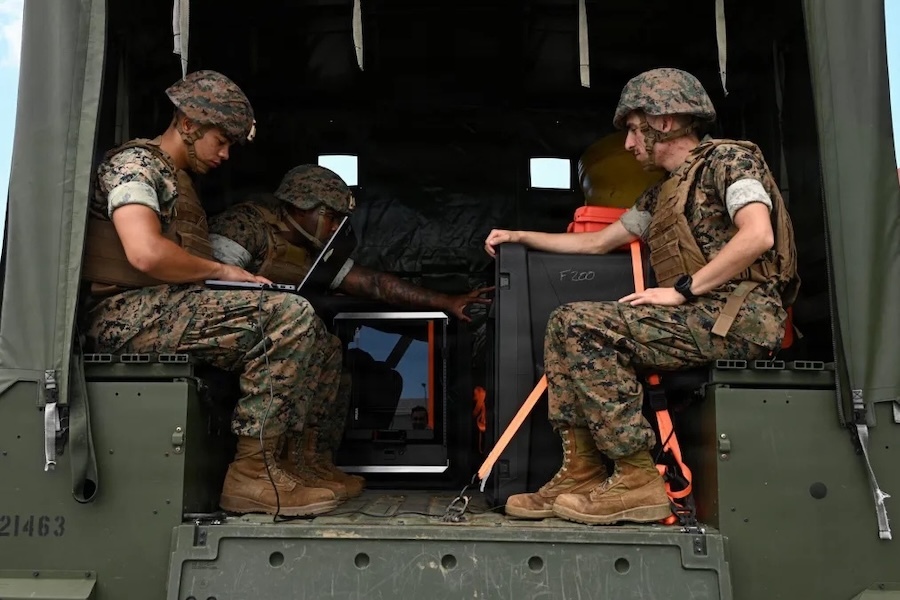
U.S. Marines with Intermediate Repair Company, 3rd Maintenance Battalion, 3rd Marine Logistics Group, prepare to test print on-the-move capabilities during Valiant Shield 26 on Camp Kinser, Okinawa, Japan, June 22, 2026. (U.S. Marine Corps photo by Cpl. Rachel Mason)
The military transferred Oshkosh IP over a new digital exchange so Marines could make their own parts
Drew F. Lawrence, Defense Scoop
The U.S. military has successfully demonstrated its nascent Digital Manufacturing Exchange (DMX) by securely transmitting Oshkosh Defense intellectual property to manufacture replacement vehicle parts locally during the Valiant Shield 2026 exercise in Japan. This platform aims to bypass contested physical supply chains in the Pacific by allowing troops to transmit data packages and manufacture critical hardware at the point of need.
- Defeating Contested Logistics: Transmitting secure digital files instead of shipping heavy physical parts provides a crucial operational alternative if physical Pacific supply chains are cut or contested during a potential conflict. The network aims to connect allied manufacturers and U.S. defense companies directly to frontline troops.
- Pricing the Digital: Developing a fair financial model to compensate defense firms for utilizing their proprietary intellectual property—without purchasing the physical end parts or buying the IP outright—remains one of the platform's most difficult hurdles.
- Broad Future Scalability: Formulated two years ago by the Joint Requirements Oversight Council to resolve a secure cross-service data-sharing gap, the Marines are now developing the exchange into an official military program of record.
Delegate to Innovate: Why Acquisition Reform Alone Can’t Fix Military Innovation (And How To Succeed Anyway)
Thane C. Clare, Center for Strategic and Budgetary Assessments
This report argues that traditional defense acquisition reforms fail because they do not address the endemic diffusion of decision-making responsibility across the Pentagon. To regain its competitive edge against China, the United States must return to its successful Cold War "delegate-to-innovate" model by empowering a single, highly tenured leader with tailored, comprehensive authority to field a specific capability.
Defense & Strategy

A worker manufactures 155 mm artillery projectiles at the Scranton Army Ammunition Plant in Scranton, Pennsylvania on April 16, 2024. The plant is one of the U.S. government's own production facilities for 155mm artillery projectile. (The Yomiuri Shimbun)
The global munitions crisis requires Foreign Military Sales reform
R. Clarke Cooper, Atlantic Council
The surging global demand for munitions is outstripping U.S. manufacturing capacity, a crisis worsened by outdated and highly bureaucratic Foreign Military Sales (FMS) processes. To support critical front-line allies and revitalize the domestic defense industrial base, the executive branch must rapidly streamline arms transfers using existing legal and executive authorities.
- Bureaucratic Delays: Under the aging Arms Export Control Act, overlapping compliance mandates, complex interagency reviews, and congressional notifications mean it takes several years to convert an ally’s initial request into a finalized contract.
- Emergency Authority Workarounds: The administration should continue using emergency provisions under existing laws to bypass lengthy congressional review timelines, a tactic successfully deployed historically to quickly reassure regional allies.
- Transitioning Sales Channels: The government can accelerate deliveries by transferring less sensitive defense hardware from the slow-moving FMS system over to Direct Commercial Sales, recognizing that many outdated "sensitive" labels no longer apply.
Related: There’s no shortcut to replenish US munitions stockpiles
Homo Post Machina: How AI and Decision Analytics Can Revolutionize Leader Performance for the Future Force
Nathan Fry, Small Wars Journal
The U.S. military must pivot from a deus ex machina mindset — relying on technology as a magical fix for complex problems — toward a model of homo post machina, which prioritizes the human behind the machine. By critiquing the Army’s tendency to overinvest in hardware while neglecting cognitive development, the text highlights how modern conflicts like the war in Ukraine demonstrate that superior equipment cannot compensate for poor leadership or rigid decision-making. To address this, the source proposes a shift toward knowledge capture and decision analytics, using AI-informed tools to replace outdated, paper-based evaluations with rich data that fosters frictionless mentorship.
Industry

Source: United States Studies Centre
Liberty Yards: US maritime revival as an alliance project
Dr. Mary Bridges, United States Studies Centre
This policy brief examines the erosion of American maritime-industrial capacity and proposes a comprehensive recovery strategy rooted in international alliance cooperation. The United States cannot reverse its shipbuilding decline through domestic isolationism alone, as it currently lags far behind the integrated maritime ecosystems developed by China. To address this, the author recommends a three-pillared approach featuring the creation of publicly owned "Liberty Yards," a specialized financing bank, and a standing industrial framework to coordinate production and maintenance with trusted partners like Australia, South Korea, and Japan.
New Initiatives at the DoW’s Office of Industrial Base Growth
Nadia Schadlow & Michael Dressler, Hudson Institute
This report examines the efforts underway at the Office of Industrial Base Growth (IBG) to advance the pool of new entrants into the defense industrial base (DIB) and further the administration’s goals for American industry. Specifically, it explores how the LYNX platform and Civil Reserve Manufacturing Network (CRMN) can be used cooperatively to expand the US DIB by raising the visibility of small and medium-sized enterprises (SMEs), giving them direct paths into the defense marketplace, and enabling them to make their extensive industrial capacity available to the DoW. It also explores how the 1260H List is increasing the transparency of US critical supply chains and how Section 805 and Section 851 aim to gradually eliminate the United States’ material dependence on China by improving cooperation with domestic manufacturers.
Government Reports

U.S. Army Capt. Alex Bayer, mechanized infantry company commander in the 4th Infantry Division, coordinates with her unit on a Next Generation Command and Control end-user device during Project Convergence-Capstone 6 (PC-C6) at Fort Irwin, California, July 24, 2026. (U.S. Army photo by Sgt. Nathan Arellano Tlaczani)
Army Modernization: Better Schedule and Cost Information Needed to Support Scaling Battlefield Network
Government Accountability Office
Installation Maintenance: Better Information on Risks and Challenges Needed to Improve Oversight of DOD Facility Conditions
Government Accountability Office
Export-Import Bank: Monitoring of Exports with Dual Military and Civilian Uses as of 2026
Government Accountability Office
Security Cooperation Workforce: DOD Plans to Fully Implement Reforms by Fiscal Year 2028
Government Accountability Office
The U.S. Army and the Golden Dome Program
Congressional Research Service
Research

U.S. Marines and Department of Defense (DOD) Civilians, attend the Defense Agencies Initiative (DAI) training course on Marine Corps Base Quantico, Va., Sept. 22, 2021. The DAI training course aims to simplify financial management across the DOD, to deliver more auditable records and improve integration through standard data structures and business practices. ( U.S. Marine Corps Photo by Lance Cpl. Brian A. Stippey)
Addressing Internal Control and Role Misalignments in the Marine Corps Defense Agencies Initiative Implementation: A Structural Perspective
Paul Armijo & Colton Rasche, Naval Postgraduate School
The Marine Corps’ transition from the Standard Accounting, Budgeting, and Reporting System (SABRS) to the Defense Agencies Initiative (DAI) brought needed improvements in financial control, audit trails, and data integration. The change fixed long-standing gaps in SABRS, but the fast turnover also exposed structural problems in how the financial management resource analyst (3451) and supply administration and operations specialist (3043) communities were organized. Work that had been handled under one system was split across several roles in DAI, but billets, training, and workforce alignment were not updated to match. This created operational friction and made it challenging to keep people, processes, and internal controls aligned. The purpose of this study is to assess how DAI affected the structure and responsibilities of the Marine Corps’ 3451 and 3043 communities. The research uses a qualitative case study supported by organizational change and alignment frameworks to examine role conflicts, segregation of duties (SoD) waivers, and workflow issues across the force. The findings highlight ongoing reliance on waivers and inconsistent DAI processes, leading to a higher workload and audit risk. Recommendations include reorganizing positions, adjusting role assignments, and enhancing governance and training to better align the workforce with DAI’s needs. These steps will help create a sustainable environment where auditability is a normal outcome of daily operations.
Advancing the inclusion of SMEs in the European Defence Technological and Industrial Base
Daniel Fiott, European Parliament
Against the backdrop of Russia’s war against Ukraine, and the rapid battlefield adaptation that it has led to, defence innovation and small and medium-sized enterprises (SMEs) are being seen as key contributors to Europe’s industrial preparedness, production scalability and security of supply. To this end, recent European Union (EU) policy and financial initiatives have specifically targeted SMEs in the defence sector, to address the financial, regulatory and industrial bottlenecks facing SMEs in Europe. However, SMEs still face considerable challenges and barriers. This Study examines the evolving role of SMEs within the European Defence Technological and Industrial Base (EDTIB). It specifically analyses the persistent barriers preventing SMEs from entering the defence market in Europe, and, once present, from scaling their innovation, services and products. The Study argues that, despite the growing political recognition of SMEs as sources of technological and disruptive innovation, SMEs still face considerable financial, regulatory and political barriers to access the EDTIB.
Events
Emerging Technologies for Defense Conference & Exhibition
NDIA
8-10 September 2026
Washington, DC
Air, Space & Cyber Conference
Air & Space Forces Association
14-16 September 2026
National Harbor, MD
Unmanned Maritime Systems Technology (UMST) USA
SAE Media Group
14-16 September 2026
Arlington, VA
Creative Disruptors by the Lakes
Creative Defense Foundations
18-19 September 2026
St. Paul, MN
2026 Undersea Warfare Fall Conference
NDIA
21-23 September 2026
Groton, CT
OCEANS 2026 Monterey
IEEE Oceanic Engineering Society (OES)
21-24 September 2026
Monterey, CA
Naval Forge 20XX: Warfare Innovation Continuum Workshop
Naval Postgraduate School
21-24 September 2026
Monterey, CA & Online
BlueTech Nexus
Naval Postgraduate School & FLEETWERX
22 September 2026
Monterey, CA
Defense Conference 26: Operationalizing Acquisition for the Warfighter
Professional Services Council
30 October 2026
Crystal City, VA & Online
One more thing...

East Tennessee native Dolly Parton smiles as she arrives for a special event held Sept. 08, 2004 at McGhee Tyson Air National Guard Base, Tennessee. She unveiled a patriotic nose art featuring her image on one of the 134th Air Refueling Wing’s KC-135 Stratotanker air refueling aircraft. The “Miss Dolly” noseart was autographed by the legendary singer and she performed several songs for the Airmen and families in attendance at the special event. (U.S. Air National Guard photo by Senior Master Sgt. Kendra M. Owenby)
Dolly Parton, Dead at 80, Spent Decades Supporting US Troops and Veterans
Ryan Thomas LaBee, Military.com
Country music icon and philanthropist Dolly Parton has passed away at age 80, leaving behind a monumental sixty-year legacy of songwriting, acting, and charity. Though she never wore a military uniform, Parton spent decades actively supporting the U.S. armed forces, leveraging her global platform to uplift deployed troops, record patriotic music, and champion literacy programs for military children.
- Unrivaled Musical Stature: Over a career spanning more than six decades, Parton sold over 100 million records, captured 11 Grammy Awards—including a Lifetime Achievement Award—and wrote timeless classics like "Jolene" and "I Will Always Love You".
- High-Flying Honor: In September 2004, Parton visited Tennessee's McGhee Tyson Air National Guard Base to unveil "Miss Dolly," an Air Force KC-135 Stratotanker featuring patriotic nose art bearing her likeness.
- Connecting with Troops: In December 2022, Parton hosted a virtual USO event, answering questions and speaking directly with active-duty service members and their families stationed around the world.
- Patriotism Through Song: Parton wrote many songs about toll of war on military families. On Veterans Day 2003, she released the album For God and Country, which combined patriotic standards with original compositions.
- Fostering Child Literacy: Founded in 1995, Dolly's Imagination Library expanded its reach to military families in 2024 through a $15,000 grant that distributed free books to children at key military bases, including Joint Base Lewis-McChord and Naval Base Kitsap.
|