Acquisition

Dry dock at Norfolk Naval Shipyard. Photo by Shelby West via DVIDS.
The Tyranny of Shipyard Cost-Plus Contracting
Kavon Hakimzadeh, War on the Rocks
Navy shipyard maintenance suffers from extensive operational delays partly caused by relying on cost-plus and level-of-effort contracts for private-sector work in public shipyards. To accelerate ship delivery, the Navy must use cost-plus contracts only during early inspection phases and transition to definitized, fixed-price contracts once repair requirements are clear.
- Misaligned Contract Incentives: Relying on cost-plus and level-of-effort contracts for private work in public shipyards reimburses labor hours rather than finished outcomes, inadvertently rewarding schedule growth.
- Accountability Trap: Adding scope changes directly to level-of-effort contracts serves as an administrative "easy button," funding extra labor hours without properly defining requirements or tying payments to progress.
- Deliberate Contracting Transition: The Navy should restrict cost-reimbursement contracting to early rip-out and inspection phases, shifting to firm-fixed-price structures once work scope is definitized.
- Empowering Procurement Officers: Contracting officers require the time and decision-making authority to scope contracts properly rather than defaulting to quick cost-plus vehicles under operational schedule pressures.
Should $500M companies compete with service-disabled veteran-owned small businesses?
Justin Brown, NavyTimes
A new Small Business Administration (SBA) proposal could force small, emerging service-disabled veteran-owned small businesses (SDVOSBs) to compete directly against multi-hundred-million-dollar corporations by drastically raising the revenue limits used to define "small" firms within the federal contracting landscape. The author argues that increasing these size standards – in some cases up to half a billion dollars – threatens the viability of service-disabled veteran-owned small businesses (SDVOSBs) by forcing true startups to compete against much larger, well-capitalized corporations. An explicit SDVOSB revenue cap or Congressional legislations can ensure the program remains a ladder for growth rather than a permanent shelter for large entities.
Call for Comments: Small Business Size Standards (due 21 Sept 2026)
Related: SBA Proposes Monumental Changes to Small Business Size Standards (Part 1)
Related: SBA Proposes Monumental Changes to Small Business Size Standards (Part 2)
Related: SBA Receives Massive Response to Proposed Size Standard Overhaul
Innovation

The Pentagon Office Building is seen from the air on August 25, 2026, in Arlington, VA. (Photo by J. David Ake/Getty Images)
Pentagon partners with venture studio to pilot shared savings contract model via $100M OTA
Brandi Vincent, Defense Scoop
The Pentagon's Chief Digital and AI Office has awarded a $100 million Other Transaction Authority agreement to venture studio Red Cell Partners to pilot a novel "shared savings" contract model. Under this performance-based framework, vendors absorb all upfront development costs and receive payment only when their AI solutions generate verified cost reductions for the military.
- Performance-Based Pay: Vendors provide AI capabilities at zero initial charge to the Department of Defense and are compensated strictly through a percentage of verified cost reductions.
- Venture Studio Pilot: Red Cell Partners acts as the prime contractor under a Other Transaction Authority deal – valued at up to $100 million in its first year – to field technology from its portfolio startups.
- Commercial Model Adaptation: Adapted from established healthcare and energy purchasing frameworks, this pilot brings a novel outcome-oriented commercial structure to defense acquisition.
- High-Profile Leadership: Red Cell was founded by healthcare executive Grant Verstandig, with a leadership team that includes former Defense Secretary Mark Esper and former Virginia Governor Glenn Youngkin.
Defense & Strategy
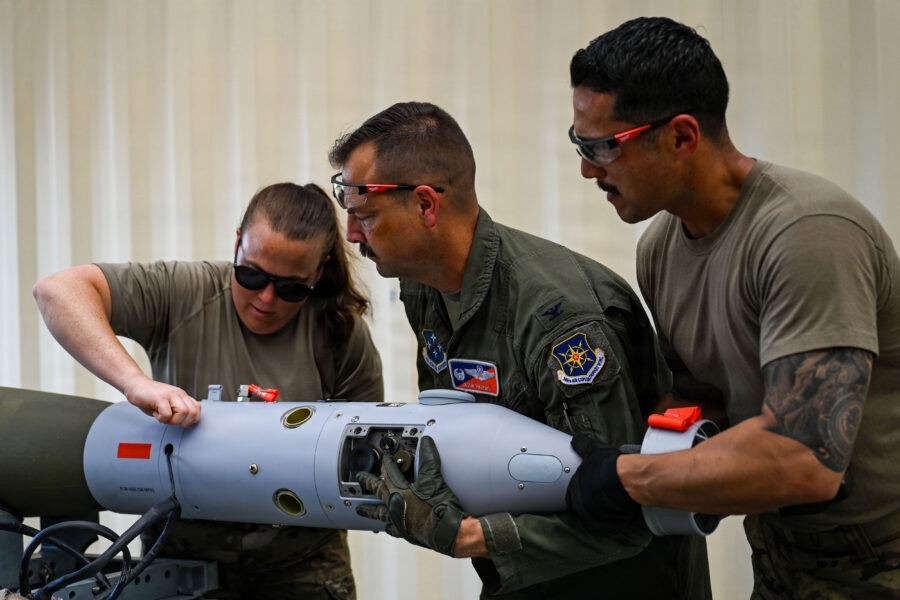
Airmen attach the computer control group on the front of a Guided Bomb Unit-49 during a leadership immersion in Ceiba, Puerto Rico, May 13, 2026. (U.S. Air Force photo by Senior Airman Megan Delaine)
Daily Code Drops at 30,000 Feet: How New Software Rules Could Help Munitions
Todd South, Air & Space Forces
A new Department of Defense instruction mandates agile, DevSecOps-driven software acquisition to allow rapid software updates for military munitions. By decoupling software development from hardware cycles and adopting commercial tech practices, the Pentagon aims to push dynamic code updates to deployed weapons on demand to counter evolving battlefield threats.
- On-Demand Updates: Experts advocate for pushing munitions software updates multiple times a day to rapidly adapt weapon effects in the field as operational needs arise.
- Preventing Stockpile Obsolescence: Without continuous software evolution, growing munitions stockpiles risk becoming obsolete against changing enemy countermeasures.
- Commercial Best Practices: The new instruction incorporates zero-trust architecture, continuous testing, code reuse, supply chain risk management, and validation standards for AI-generated code.
Instruction: Accelerated Mission Software
AUKUS Turns Five: Real Progress, Hard Challenges Ahead
Jonathan Ahlstrom and Charles Edel, Center for Strategic and International Studies
Five years after its establishment, the AUKUS security partnership between Australia, the United Kingdom, and the United States has achieved substantial institutional, legal, and training progress toward building a nuclear-powered submarine capability in the Indo-Pacific. However, workforce shortages and sluggish American submarine production act as critical "limiting reagents."
- Institutional Progress: Joint military training and base infrastructure are expanding rapidly, with Australian personnel embedded in U.S. nuclear pipelines and the establishment of Submarine Rotational Force-West at HMAS Stirling.
- Legal Foundations: All three partner nations have enacted critical enabling legislation, including 50-year treaties, export control reforms, and ITAR exemptions to facilitate technology and material transfers.
- Industrial Base Bottlenecks: Production targets for U.S. Virginia-class submarines have slipped to 2032, creating potential timeline friction for transferring boats to Australia as planned in the early 2030s.
- Workforce Deficits: Australia, the UK, and the U.S. face severe shortages of nuclear-qualified tradespeople, raising concerns about retaining trained Australian workers before their own submarines arrive.
- Pillar II Advancements: Advanced technology collaboration has achieved initial milestones in hypersonic testing, deep-space radar, sonar AI, and shared unmanned underwater vehicle (UUV) payloads.
Government Reports
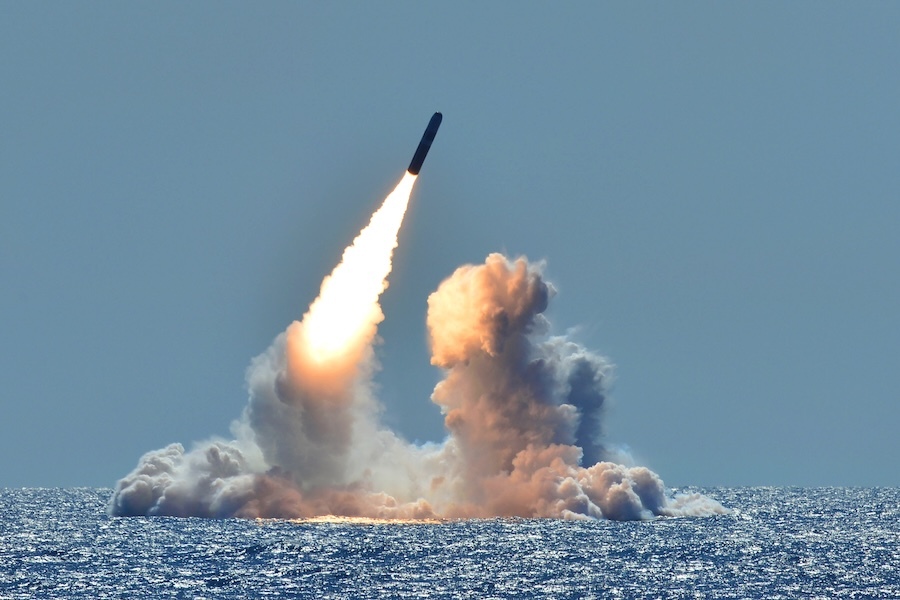
An unarmed Trident II D5 missile launches from the ballistic missile submarine USS Nebraska off the coast of California, March 26, 2018. The test launch was part of the U.S. Navy Strategic Systems Program’s demonstration and shakedown operation certification process. (Photo by Navy Petty Officer 1st Class Ronald Gutridg)
FY2027 Defense Budget: Funding for Selected Weapon Systems
Congressional Research Service
FY2027 NDAA: Status of Legislative Activity
Congressional Research Service
The Army’s XM-30 Mechanized Infantry Combat Vehicle
Congressional Research Service
U.S. Marine Corps Ground Combat Element 2040 Initiative
Congressional Research Service
DOD Installation Services: Action Needed to Improve Oversight of Intergovernmental Support Agreements
Government Accountability Office
Defense Management: DOD Needs to Review Its Defense Agencies and Field Activities for Efficiency and Effectiveness
Government Accountability Office
Testing and Evaluation Guide: Best Practices for Commercial Off-the-Shelf Systems
Government Accountability Office (Exposure Draft)
Research
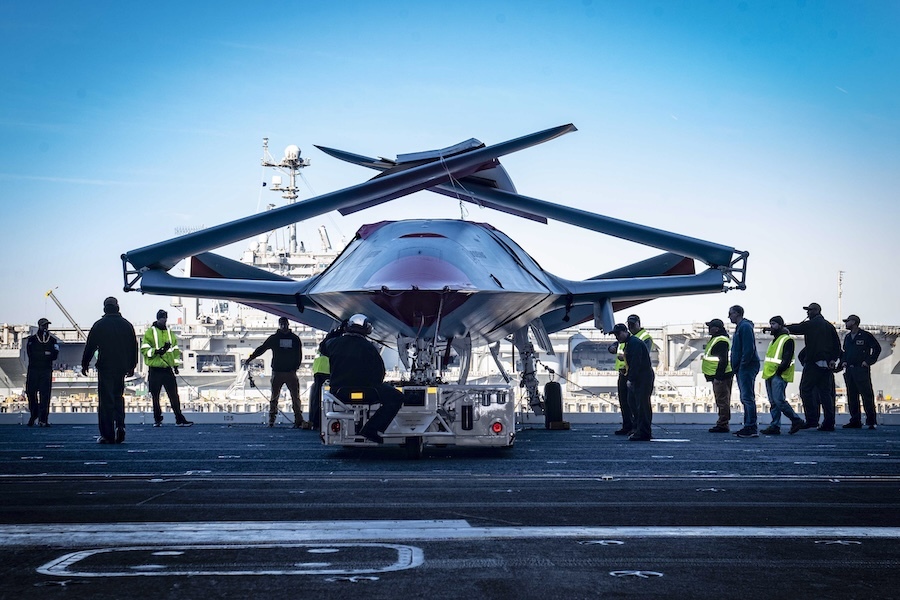
Sailors and Boeing team members prepare to move an unmanned MQ-25 Stingray aircraft into the hangar bay of the aircraft carrier USS George H.W. Bush in Norfolk, Va., Nov. 30, 2021. The MQ-25 will be the world’s first operational, carrier-based unmanned aircraft. (Photo by Navy Petty Officer 3rd Class Noah J. Eidson)
An Economic Analysis on Risk Sharing, Incentivization, and Defense Procurement Contract Design in the Major Defense Acquisition Program Setting
Daniel Miller & James Clift, Naval Postgraduate School
This thesis aims to answer: What is the optimal contract structure for achieving effective risk-sharing and incentivizing performance in MDAPs? Theoretical modeling and mathematical simulation are used to analyze and solve these issues and provide acquisition professionals with a practical tool to combat information asymmetry when contracting for developmental efforts of MDAPs. The research concludes that a dynamic, risk-adaptive incentive model that evolves with program maturity is most effective in combating asymmetric information. Specifically, modifying the standard cost-plus-incentive-fee (CPIF) structure where target profit and share-ratio are variables of target cost was found to be most effective when technical risk and uncertainty are high. This study recommends integrating mechanism-based analysis into defense contracting to enhance MDAP acquisition strategies, as well as Budget Based Cost-Plus Incentive Scheme (BBCPS) incentive mechanism for developmental efforts of MDAPs.
The 2-D Orthogonal Packing Problem with Multiple Levels of Prioritization: A Spatial Optimization Perspective
William K. Kirschenman, H. Sebastian Heese, et al, Naval Research Logistics
This paper addresses two-dimensional orthogonal packing within a confined space, integrating bin packing principles with facility layout concepts to address scenarios in which items must not only fit but also be arranged according to spatial priorities. We embed a prioritization matrix into the bin packing framework, enabling items to be clustered with one another or pulled toward certain bin access points based on assigned priority weights. Unlike traditional bin packing, which often minimizes bin count or unused space, our approach balances proximity to bin access points and adjacency among functionally related items already assigned to a given bin, extending the utility of bin packing to applications requiring more nuanced layout preferences. We introduce a single mixed-integer linear programming (MILP) model and a complementary sliding-window matheuristic that scales effectively to larger problem instances. Numerical experiments illustrate that this matheuristic approach consistently outperforms a direct MILP solve with a commercial solver in both runtime and solution quality, and also performs best among the adapted heuristic and metaheuristic alternatives considered in our study. This computational study underscores the flexibility and effectiveness of embedding multilevel priorities into orthogonal packing.
Breaking Glass, Missing Hands: Addressing Workforce Constraints That Threaten the Resilience of the Space Industrial Base
Alexandra Gerber, RAND
This report by the RAND Corporation explores how severe workforce shortfalls within the American space defense sector jeopardize the nation's ability to quickly reconstitute military capabilities during a conflict. The authors identify a lack of qualified STEM engineers, specialized technicians, and cleared personnel, noting that the long lead times required to train these experts create a dangerous resilience gap. To solve this, the text proposes a comprehensive cultivate–train–qualify–retain framework that requires the U.S. Space Force to lead industrial partners via increased educational funding and strategic automation incentives.
Events
2026 Undersea Warfare Fall Conference
NDIA
21-23 September 2026
Groton, CT
OCEANS 2026 Monterey
IEEE Oceanic Engineering Society (OES)
21-24 September 2026
Monterey, CA
Naval Forge 20XX: Warfare Innovation Continuum Workshop
Naval Postgraduate School
21-24 September 2026
Monterey, CA & Online
BlueTech Nexus
Naval Postgraduate School & FLEETWERX
22 September 2026
Monterey, CA
Defense Conference 26: Operationalizing Acquisition for the Warfighter
Professional Services Council
30 October 2026
Crystal City, VA & Online
CALL FOR PAPERS & PANELS: Delivering Warfighting Capability
Naval Postgraduate School 24th Annual Acquisition Research Symposium & Innovation Summit
12-13 May 2027
Monterey, CA
Proposals Due: 17 November 2026
One more thing...

The “Crusading for Right” statue, also known as “Iron Mike,” stands outside Butler Hall at Marine Corps Base Quantico, Virginia, Aug. 16, 2026. The bronze monument, created in 1918 by French sculptor Charles Raphael Peyre, depicts a World War I U.S. Marine holding an M1903 Springfield rifle. (U.S. Marine Corps photo by Lance Cpl. Lynsee Avila-Ramirez)
Crusading for Right' or 'Iron Mike'? The true story of Quantico's iconic statue
Staff Sgt. Bryce Hodges, USMC News
Created by French sculptor Charles Raphaël Peyre after World War I, the iconic "Crusading for Right" statue at Marine Corps Base Quantico honors the courage of Marines who fought at Château-Thierry on the Western Front during World War I. Modeled after a twice-wounded Marine private, the monument stands outside Butler Hall as an enduring symbol of battlefield valor.
- Battlefield Inspiration: Following the 1918 Battle of Château-Thierry, French soldier and sculptor Charles Raphaël Peyre sought to immortalize the invincible energy of American troops.
- Real Marine Model: Peyre selected Pvt. Carl J. Millard, a twice-wounded 5th Marine Regiment veteran from Chicago, to pose in his mud-caked combat gear.
- Full-Scale Commission: After Marine leadership viewed a two-foot draft in Paris, the Marine Corps commissioned an eight-foot bronze version featuring official uniform insignias.
- Historic Quantico Dedication: Officially titled "Crusading for Right," the completed eight-foot sculpture was dedicated outside Quantico’s Butler Hall on December 8, 1921.
- Commemorative Plaques: The statue's base features three bronze plaques honoring the fallen officers and men of the 5th Regiment, 6th Regiment, and 6th Machine Gun Battalion.
- Common Name Confusion: Although Marines frequently refer to the monument as "Iron Mike" - a name given to men who showed extreme bravery and courage during WWI – that moniker officially belongs to a separate 1924 statue located at Parris Island.
|