Acquisition

Image: U.S. Army via Wikimedia Commons.
The Unhedgeable Bet: What the Future Combat Systems Can Teach Us About Acquisition
Andrew Tenbusch, War on the Rocks
Analyzing the failure of the U.S. Army's Future Combat Systems (FCS), this article warns that modern defense initiatives like Golden Dome risk repeating history by over-relying on tightly coupled, interdependent networks without independent oversight.
- Catastrophic FCS Failure: The U.S. Army spent $18 billion over six years on Future Combat Systems before its 2009 cancellation – making an unhedgeable bet on 18 unproven, interdependent systems.
- Inflexible Program Architecture: Because its systems were tightly coupled, FCS could not be de-scoped or downsized to reduce costs without requiring complex software rewrites across all dependent components.
- Independent Oversight Essential: FCS was kept alive by the sunk cost fallacy, regional subcontracting across 100+ congressional districts, and institutional pride that prevented internal managers from admitting failure.
- Modern Interdependence Warnings: The multi-billion-dollar Golden Dome missile defense shield mirrors FCS vulnerabilities by depending heavily on a new, not-yet-fielded command-and-control network (likely the Joint Fires Network, which the Golden Dome program does not own or control) a 1,000-satellite constellation that can't be scaled down without creating coverage gaps.
- Final Integration Gate: Because concept-level interdependence is tested only at the end—when sunk costs, political momentum, and pressure are highest—authority over the final gate must be assigned to an independent outside body empowered to fail unviable programs outright before production.
JCIDS is Dead. The Services Dug It Back Up
Pete Modigliani and Matt MacGregor, Defense Tech & Acquisition
Despite formal directives to abolish the bureaucratic Joint Capabilities Integration and Development System, military branches continue to rely on outdated, paper-bound workflows that severely hamper innovation. Rather than genuinely reforming their procedures, defense organizations merely recreate streamlined variations of legacy systems instead of embracing modern, data-driven portfolios. To achieve true agility, leaders must abandon rigid documentation entirely in favor of dynamic digital repositories shaped by real-time operational feedback, ongoing experimentation, and active collaboration with industry partners.
BREAKING: Comment Period on Proposed Size Standards and Methodology Extended to November 20, 2026
John Holtz, Small Government Contracts
The Small Business Administration (SBA) has extended the public comment period for its proposed small business size standard changes to November 20, 2026, following a wave of overwhelmingly negative feedback and a drastic revision in its impact estimates.
- Rule Changes: The SBA's August 19, 2026 proposed rules would significantly raise size standards across federal contracting industries, simplify categorizations, and transition several sectors from receipts-based to employee-based standards.
- Impact Revision: The SBA abruptly lowered its estimate of newly eligible small businesses from 114,000 down to between 4,000 and 6,000, though it failed to publish the data or underlying analysis supporting this new figure.
Submit a Comment: Small Business Size Standards
Innovation

Image via Venus Aerospace
Little Bang Theory: Advanced Propulsion Shows Promise
Alek Jovovic & Oliver Buntin, RealClearDefense
Persistent shortages in conventional rocket motors and long-range interceptors are driving defense primes and the Pentagon to look beyond traditional suppliers toward rotating detonation engine (RDE) technology. By partnering with commercial tech startups, major defense integrators aim to diversify the industrial base, lower production costs, and scale next-generation missile manufacturing.
- Prime-Startup Integration: Major defense integrators like Lockheed Martin are taking financial stakes in and partnering with startups like Venus Aerospace to connect commercial RDE prototypes directly with missile-integration programs.
- Diversifying Supply Chains: Transitioning RDE development from legacy prime duopolies to non-traditional aerospace firms creates needed manufacturing competition and expands overall defense industrial capacity.
- Manufacturing Scaling Barriers: Broad military deployment hinges on industry overcoming severe thermal challenges to demonstrate repeatable manufacturing, acceptable unit costs, and long-term storage stability.
Defense & Strategy

Air Force Senior Airman Ryan Perreira inspects an AIM-9X missile on an F-15E Strike Eagle (Air Force photo by Senior Airman Grace Turpin)
Newest AIM-9X Missiles Not Meeting Operational Availability Goal
Todd South, Air and Space Forces
Recent Pentagon reports reveal that the military's primary air-to-air weapon, the AIM-9X Sidewinder Block II, is failing to meet operational availability goals due to hardware and software integration setbacks. This readiness shortfall has created a severe lack of training asset availability, leaving fighter pilots without enough operational pods to practice vital combat tracking maneuvers.
Related: Modernized Selected Acquisition Report (MSAR) AIM-9X Block II Sidewinder (AIM-9X Blk II)
Industry

A Navy rendering of Boeing's F/A-XX aboard a carrier. (NAVAIR via Boeing)
Boeing wins Navy next-gen fighter F/A-XX competition
Valerie Insinna and Michael Marrow, Breaking Defense
The U.S. Navy has selected Boeing over Northrop Grumman for a full-scale development contract valued at over $20 billion to build its next-generation F/A-XX strike fighter
- Massive Development Contract: Valued at more than $20 billion, the full-scale development phase procures multiple test aircraft for ground, airworthiness, systems, and weapons testing, with initial flights slated for the 2030s.
- Sixth-Generation Market Monopoly: Securing the F/A-XX contract establishes Boeing as the sole manufacturer of sixth-generation U.S. fighter jets, effectively icing out major rivals Lockheed Martin and Northrop Grumman after winning the Air Force's F-47 program.
Trump's FBI shut down investigation into defense contractor's alleged bribes
William Turton, Avi Asher-Schapiro, Molly Redden and Kirsten Berg, Defense One / Pro Publica
A former defense contractor CEO confessed to a multi-million-dollar pay-to-play scheme funneling illicit political donations to federal lawmakers in exchange for millions in unmerited military funding. Although federal agents and prosecutors gathered compelling evidence to launch a sweeping congressional bribery probe, the inquiry ultimately collapsed because the incoming presidential administration dismantled anti-corruption units and ousted the leading investigators.
Government Reports
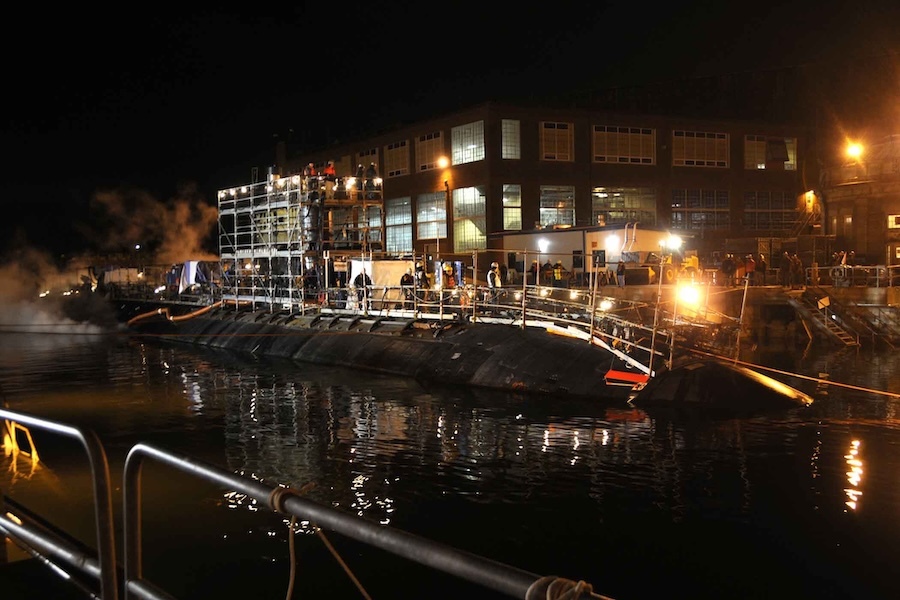
The Los Angeles-class attack submarine USS Miami enters dry dock to begin an engineered overhaul at Portsmouth Naval Shipyard in Maine, March 15, 2012.
Naval Shipyards: Complete Information Needed for Decision-Making on Multibillion-Dollar, 50-Year Infrastructure Program
Government Accountability Office
Small Business Research Programs: Better Data Could Improve Insight into Companies’ Success
Government Accountability Office
Military Installations: Remote and Isolated Locations Face Challenges Delivering Critical Support Services
Government Accountability Office
Research
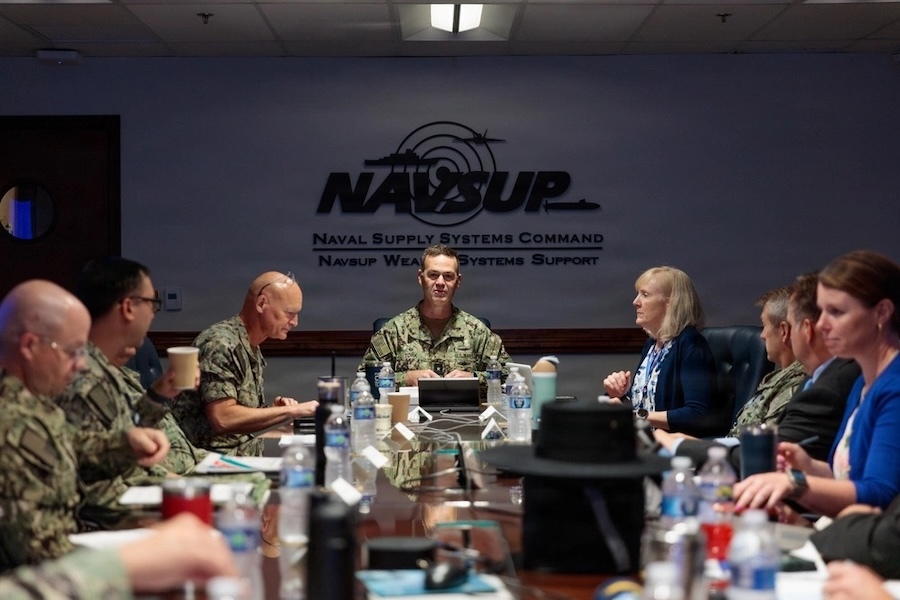
NAVSUP WSS Hosts Submarine Leadership to Strengthen Industrial Base and Fleet Readiness (Navy photo by Scott Mundy)
Analyzing Slow-Moving Inventory within NAVSUP NWCF-SM: A Decision-Support Dashboard for Global Inventory Positioning
Justin Riddick & Byron Montgomery, Naval Postgraduate School
The Navy Working Capital Fund–Supply Management (NWCF–SM) maintains secondary inventory across a global network, yet oversight reviews continue to identify high-value material that remains inactive at one location while the identical National Item Identification Number (NIIN) shows sustained demand elsewhere. This study examines whether NIIN–plant stock positioning is frequently misaligned with observed demand and whether a repeatable NIIN-level analytic view can identify the largest concentrations of slow-moving inventory. Using Navy Enterprise Resource Planning (ERP) data accessed through Advana, NIIN–plant positions with positive unrestricted on-hand quantity were classified as slow movers when no issues occurred in the most recent three fiscal years and cumulative five-year issues were less than or equal to 20 percent of on-hand quantity. Within an unrestricted portfolio valued at just under $50 billion, approximately $24 billion meets the slow-moving or low-velocity criteria. This exposure is highly concentrated: the Defense Logistics Agency, Commander, Pacific Fleet, and United States Fleet Forces Command together account for roughly 82 percent of slow value, and fewer than ten locations hold the majority of slow dollars and units. The primary deliverable is a filterable Tableau dashboard that enables consistent cross-plant velocity comparisons, highlights geographic demand mismatches, and supports audit readiness by providing NIIN-level evidence for targeted review.
Determining the Days of Supply for Class 1 Inventory Aboard U.S. Navy Ships
Sean Harlow, Marc Walker & Spencer Wilson, Naval Postgraduate School
This research addresses inconsistencies in calculating days of supply (DoS) for Class I inventory aboard U.S. Navy vessels, a challenge that threatens operational readiness in contested logistics environments. To achieve this, we analyzed nine months of historical consumption data from the Food Service Management System (FSM3) across 14 ship classes, examining the alignment between current DoS calculation methods and actual at-sea consumption patterns. Our analysis uncovered key issues: the reliance on dollar-value-based calculations that ignore consumption variability, the application of uniform assumptions across diverse ship classes, and disparities between reported DoS estimates using different Navy systems. To address these challenges, we developed the Supply Select App, an interactive R-based tool that provides fleet commanders with accurate Food Item Code (FIC)-level usage data tailored to specific ship classes. The app employs three core metrics: average daily consumption, projected DoS, and projected order quantity, which are derived from empirical consumption records rather than financial approximations. This research highlights the urgent need for data-driven approaches in naval sustainment, focusing on operational autonomy and resilience in communications-denied environments. The Navy’s adoption of evidence-based logistics tools is crucial to maintain combat readiness and mission continuity while ensuring accurate sustainment of its deployed personnel.
Reimagining U.S. Industrial Mobilization
Alexis R. Johnson, Joint Force Quarterly
This paper identifies a critical vulnerability in U.S. defense sustainment strategy and proposes a solution: the Civil Reserve Sustainment Readiness Program (CRSRP). The CRSRP focuses on bolstering Maintenance, Repair, and Overhaul (MRO) capabilities. Given the intensifying great power competition and the increasing likelihood of a contested conflict in the Indo-Pacific, the current Organic Industrial Base (OIB) lacks the surge capacity and agility necessary for rapid, distributed sustainment. Drawing on historical lessons from World War II and contemporary analysis of OIB limitations, this study details how the CRSRP would leverage public-private partnerships, incentivize commercial sector participation, and utilize digital tools like the VIGOR (Visualized Integration of Government and Organic Readiness) platform to enhance readiness visibility and accelerate mobilization. Key recommendations include enacting a new Title VIII to the Defense Production Act, implementing governance reforms, and establishing legal frameworks to address intellectual property and data-sharing concerns. The CRSRP offers a strategic force multiplier, enabling the Department of Defense to seamlessly integrate commercial infrastructure and expertise with military sustainment, thereby bridging the gap between industrial production and operational endurance.
Events
DEFCON
Stanford University
7 October 2026
Palo Alto, CA
AUSA Annual Meeting & Exposition
Association of the United States Army
12-14 October 2026
Washington, DC
TechNet Indo-Pacific 2026
AFCEA
26-29 October 2026
Honolulu, HI
Silicon Valley Space Week
SatNews
27-29 October 2026
Mountain View, CA
Defense Conference 26: Operationalizing Acquisition for the Warfighter
Professional Services Council
30 October 2026
Crystal City, VA & Online
One more thing...

A new U.S. Postal Service stamp honors the U.S. Coast Guard Academy's 150th anniversary. It features photos taken by two Coast Guard photographers. (U.S. Postal Service)
Coasties’ photos used on stamps honoring Coast Guard Academy’s 150th
Karen Jowers, NavyTimes
The U.S. Postal Service is honoring the U.S. Coast Guard Academy’s 150th anniversary with a commemorative Forever stamp featuring photographs taken by active Coast Guard photographers. Designed by USPS art director Antonio Alcalá, the 12-million-stamp issue celebrates the service's maritime legacy by pairing its historic sail-training vessel with a modern national security cutter.
- Coasties' Lenses: The stamp features real-world operational photographs taken by Coast Guard Petty Officer 1st Class Steven Strohmaier and Petty Officer 2nd Class Matthew Thieme.
- Dual Vessels: The visual design juxtaposes the U.S. Coast Guard Barque Eagle, the academy's primary training sailing ship since 1946, alongside the contemporary Legend-class national security cutter USCGC Bertholf.
- Deployment Snapshot: Strohmaier captured the featured photo of the cutter Bertholf on Feb. 29, 2024, while deployed off the coast of Singapore.
- Academy Tradition: The new issue continues a long-standing Postal Service tradition of creating special stamps to honor American military service academies.
|