Acquisition

Army Materiel Command advanced manufacturing lead for small UAS, Jon Strzelec, and Army Materiel Command principal technical advisor, Carolyn Farmer, being interviewed by Terry Gerton of Federal News Network at the Association of the United States Army (AUSA) Annual Meeting & Exposition in October 2026.
For Army advanced manufacturing, 3D printing was just a start
Terry Gerton, Federal News Network
Army Materiel Command is transforming military sustainment by establishing a broad advanced manufacturing ecosystem that goes beyond 3D printing to encompass digital supply chains, point-of-need production, and agile contracting
- Shifted Lifecycle Focus: Rather than maintaining traditional long-term spare part inventories, lifecycle management is pivoting toward rapid item replacement and continuous feedback loops for attritable systems like small drones.
- Tactical Edge Production: Manufacturing low-risk replacement parts directly at or near forward operational units enables soldiers to restore system readiness quickly without waiting on long-distance factory supply chains.
- Modern Part Re-Engineering: When older components become obsolete or unavailable, the Army can re-engineer parts using modern techniques and digitally distribute production files straight to field units.
- Arsenal Co-Investment: To scale production capacity, the Army is forging public-private partnerships across its 23 arsenals and depots, offering underutilized industrial space and facilities to commercial partners.
- Secure Digital Exchange: Through the Digital Manufacturing Exchange, the Joint Force securely transmits digital manufacturing files while offering flexible "IP as a service" models to protect commercial intellectual property.
- Agile Commercial Contracting: By utilizing Commercial Solutions Openings, Army Contracting Command evaluates industry proposals continuously on individual technical merit, cutting award timelines down to 38 days.
Accelerating the Fielding of Capabilities for Combatant Commands: Designating Combatant Commanders as Executive Agents for Joint Operational Problems
Andrés Guerrero-Cordero, Eric Obergfell, and Nicholas Tran, MITRE
This MITRE report advocates designating Combatant Commanders (CCDRs) as Executive Agents (EAs) for resourced Joint Operational Problems (JOPs) to direct funding toward integrated warfighting capabilities. This policy shift empowers operational commanders to eliminate domain bias, overcome Service-centric bottlenecks, and accelerate fielding without requiring complex legislative reform.
- Acquisition Reform Gap: Despite 2025 acquisition reforms and new experimentation authorities under the FY2026 NDAA, combatant commanders still lack the resourcing power required to resolve complex joint capability gaps.
- Executive Agent Empowerment: Designating commanders as Executive Agents gives them authority to review and direct resourcing for Joint Operational Problems, ensuring solutions align with their theater's specific integration needs.
- Bridging the Valley: Executive Agent authority allows commanders to steer funding toward prototyping, overcome the acquisition "Valley of Death," and expedite fielding for Joint Command and Control systems.
Innovation
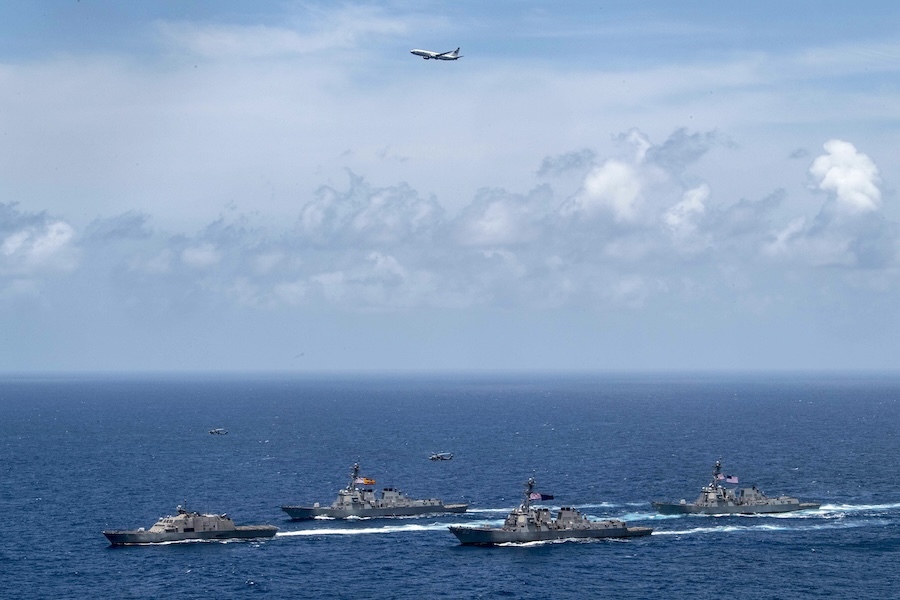
The littoral combat ship USS Detroit travels in formation with the guided missile destroyers USS Lassen, USS Preble and USS Farragut, as well as a Navy P-8A aircraft while conducting maritime security operations in the Caribbean Sea, May 11, 2020. (Navy Petty Officer 2nd Class Anderson W. Branch)
Creating the Foundry — Organizational Learning and Technology Innovation Leadership in the United States Navy
David H. Lewis, Naval War College Journal
This article by NPS professor of the practice Dr. Dave Lewis, VADM USN (ret.), examines how the U.S. Navy has adopted emerging technologies across four industrial revolutions and identifies practices that could improve its adoption of artificial intelligence, autonomy, and other Fourth Industrial Revolution capabilities. Historical cases—from steam propulsion and ironclads to nuclear power, Polaris, and Aegis—show that successful innovation depended on empirical experimentation, iterative learning, sustained technical leadership, operational-user involvement, and semiautonomous organizations.
Today, centralized acquisition processes, fragmented authority, and institutional resistance favor incremental improvements to existing platforms over exploration of disruptive technologies. To reverse this decline, the article proposes “maritime progressive realism,” which combines empirical learning, adaptive leadership, and institutional self-examination with operational and resource constraints. It recommends formal learning reviews, innovation training for senior leaders, separate acquisition pathways for enabling and replacement technologies, stronger collaboration among the fleet, industry, and researchers, and agile implementation of the Warfighting Acquisition System.
Hammers and Nails: Military Innovation as a Strategic Dead End
Matthew Ford, Military Strategy Magazine
Modern military institutions increasingly treat technological innovation as a substitute for strategic choice, allowing leaders to defer difficult political decisions about force structures and industrial capacity by promising future tech-driven solutions. Tracing this mindset from Cold War doctrines through post-9/11 counterinsurgency failures to contemporary artificial intelligence initiatives, the text highlights how armed forces are trapped in technological determinism that mistakes sophisticated digital tools for a coherent plan for victory. Furthermore, this obsession with perpetual experimentation fosters a dangerous dependency on private-sector tech companies, eroding national sovereignty as sovereign defense capabilities rely more on commercial software contracts than public authority.
Defense & Strategy

An aviation machinist’s mate adjusts a 3D printer on board the USS Boxer (LHD-4) as the ship steams in the Pacific Ocean in January 2024. By 2025, additive manufacturing had cut some part lead times by 70 percent. U.S. Navy (Roland Ardon)
The Urgent Need for Manufacturing at Sea
Annabelle Hutchinson and Irene Loewenson, Proceedings
The U.S. Sea Services must rapidly scale shipboard 3D printing to overcome severe logistics vulnerabilities in contested environments. Deploying industrial additive manufacturing directly on warships enables sailors to produce replacement parts at sea, reducing dependence on long supply lines and sustaining fleet readiness.
- Accelerated Production: Afloat additive manufacturing has already slashed component lead times by up to 70 percent, producing critical replacement items ranging from water purification components to operational drones during exercises.
- Foreign Competitor Advantage: China's navy has used 3D printers on warships since 2015, whereas the vast majority of U.S. military additive manufacturing funding remains concentrated in onshore domestic shipyards.
- Intellectual Property Barriers: Defense contractors hesitate to share digital technical data packages due to lost replacement part revenue, requiring new licensing frameworks, subscription models, or statutory reforms.
- Centralized Flag Leadership: Appointing a dedicated flag officer would establish senior accountability to coordinate programs, negotiate data rights with contractors, and advocate for legislative updates.
- Dedicated Workforce Pipeline: Effective October 2026, the Marine Corps merged metalworking and machining specialties into a single "fabrication specialist" MOS to build forward-deployed 3D printing expertise.
- Broad Fleet Training: Training all shipboard technicians in basic 3D printing—supported by AI design tools and remote learning—ensures point-of-need production continues even under battle damage conditions.
Related: 3D printed $1,000 fix that replaces $200,000 submarine alteration
Industry
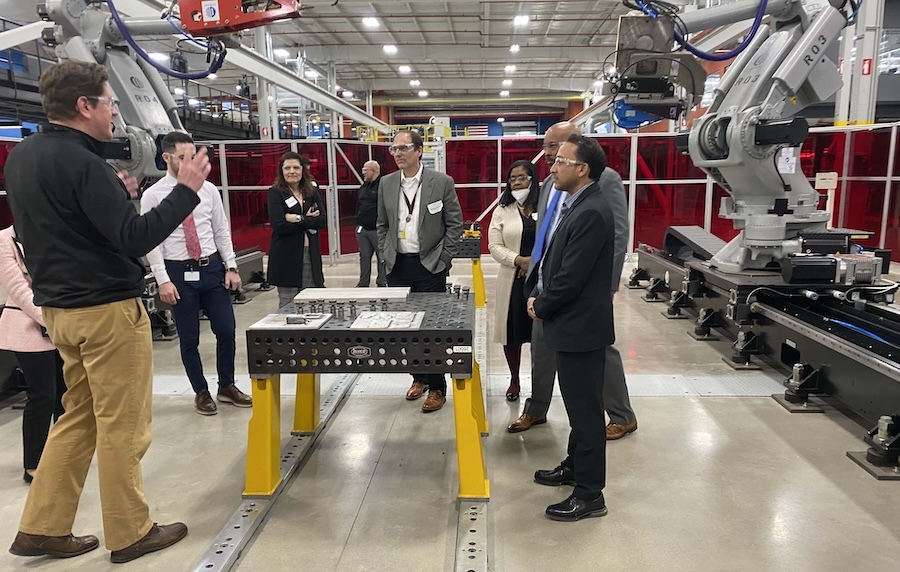
Department of Defense Office of Small Business Programs Director, Farooq Mitha, visited the LIFT Manufacturing Innovation Institute in Detroit in March 2022. (Photo credit: Devon Bistarkey, DOD)
National Security Commission on Robotics for Advanced Manufacturing: Preliminary Report
Special Competitive Studies Project (SCSP)
The Special Competitive Studies Project (SCSP) preliminary report warns that while the United States leads in AI innovation, it lags drastically behind China in industrial robotics deployment and manufacturing capacity. To prevent losing leadership in the physical AI era, the report calls for a national strategy to overcome high costs, institutional fragmentation, and component supply bottlenecks.
- Stark Deployment Deficit: In 2025, China installed 354,200 industrial robots—59% of global installations—compared to just 38,400 in the U.S., expanding China's operational stock to over two million units while U.S. deployment lags at 393,700.
- Supply-Demand Paradox: A market coordination failure stalls the U.S. robotics flywheel, as manufacturers defer adoption until costs drop and integration simplifies, while robotics vendors cannot lower prices without high-volume orders.
- Institutional Fragmentation: Federal robotics initiatives remain scattered across disconnected agencies without a single authority or strategy, forcing firms to navigate a confusing maze of uncoordinated technical and financial programs.
- Workforce Mismatch: A persistent shortage of qualified integration technicians constrains robotics adoption, while up to 1.9 million U.S. manufacturing roles risk going unfilled by 2033.
- Scale Financing Gap: U.S. robotics startups face a commercialization "valley of death" because venture capital timelines conflict with hardware manufacturing costs and buyers demand proven field reliability.
Research
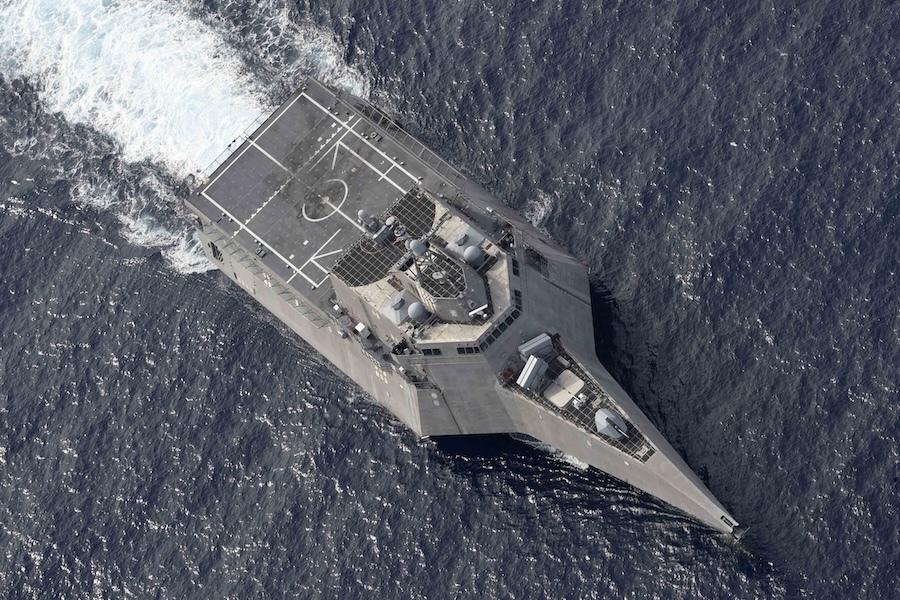
The Independence-variant littoral combat ship USS Gabrielle Giffords conducts routine operations in the South China Sea, June 30, 2020. Photo by Navy Petty Officer 2nd Class Brenton Poyser
Introducing Prospect Theory into Defense Acquisition Strategy: Framing Early Decisions for Joint Warfighting Advantage
Stephan Lubosch, Naval Postgraduate School
In an age of renewed great-power competition, accelerating acquisition processes is a necessity. Achieving speed, however, depends on refining the early framing and conceptual phases of programs to deliver value to the warfighter and enable Joint Warfighting Concepts. This study introduces prospect theory, developed by Kahneman and Tversky, as a decision tool for understanding how pressures related to time, cost, schedule, and risk can distort choice sets in major defense acquisition programs (MDAPs). These pressures can introduce biases that override objective analysis and logical acquisition pathways. Through an analysis of acquisition behavior and program documentation related to the Littoral Combat Ship (LCS) and the Integrated Combat System (ICS), this study shows how misaligned framing can lead to prolonged corrective actions, while alignment with acquisition best practices and Joint Force requirements can improve program outcomes. The study further proposes artificial intelligence (AI) as an auditing tool to identify early bias and improve alignment among acquisition pathways, force-structure development, and Joint Force capability needs.
The Silicon Backbone: Mapping and Analyzing the U.S. DoD Semiconductor Supply Chain
Brett Reichert, Cornell University
This dissertation examines how the U.S.Department of Defense can identify and govern hidden dependencies in the semiconductor supply chain. It constructs a DoD-anchored, provenance-aware network that combines three evidence layers: disclosed supplier relationships from public and commercial sources, predicted links inferred through leakage-safe link-prediction models, and observed links derived from shipping data. Together, these layers produce a decision-grade map of semiconductor dependence rather than a complete census of the supply chain.
Methodologically, the dissertation develops a reproducible workflow for extending visibility under partial observability while preserving the distinction between disclosure, inference, and observation. Using fixed candidate pools, temporal evaluation, calibrated ensembling, and conservative operating rules, it recovers likely hidden tiers and prunes the broader supplier network to the defense-relevant semiconductor subgraph.
The analysis shows that vulnerability is not evenly distributed. It concentrates in chokepoints, corridor intermediaries, and brittle paths that can deny or degrade semiconductor support to DoD-linked prime contractors if disrupted. The dissertation evaluates structural consequence conditional on disruption through reachability loss, flow-based impact, brokerage, and path redundancy, while treating disruption probability as a separate concept not estimated directly. It concludes with a policy framework centered on decision-grade visibility, traceability, and acquisition practice, so that Tier-2+ dependencies that matter for continuity and trust become governable before crisis exposes them.
Events
TechNet Indo-Pacific 2026
AFCEA
26-29 October 2026
Honolulu, HI
Ironclad Maritime Summit
27 October 2026
Norfolk, VA
Silicon Valley Space Week
SatNews
27-29 October 2026
Mountain View, CA
Portfolios Not Programs: Transitioning to the New Paradigm
Warfighting Acquisition University
28 October 2026
Virtual
Deep Dive Into the Defense Industrial Base Part 2
Warfighting Acquisition University
28 October 2026
Virtual
Defense Conference 26: Operationalizing Acquisition for the Warfighter
Professional Services Council
30 October 2026
Crystal City, VA & Online
Convening in the Capital: Autonomy at Scale
Vanderbilt University’s Institute of National Security
18 November 2026
Washington, DC
One more thing...
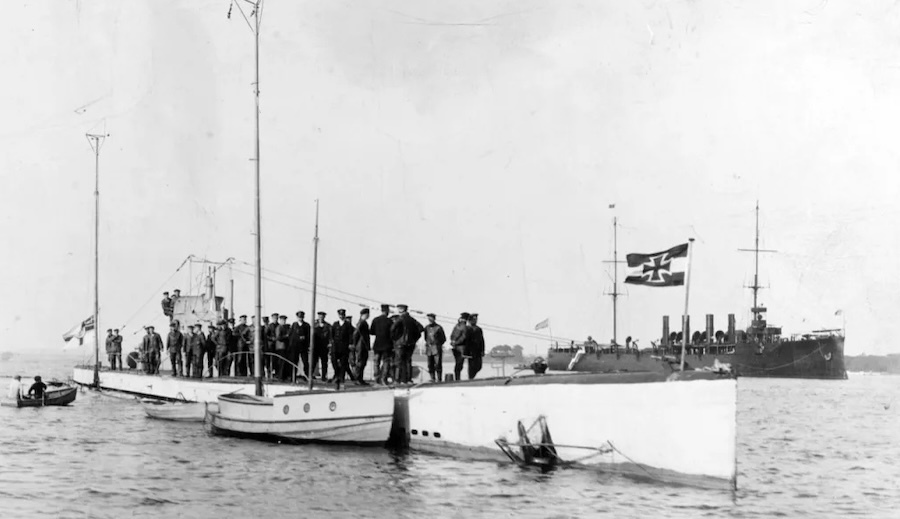
The U-53’s visit to American shores was a propaganda move designed to shock the United States into fearing the far-reaching dangers of German submarine warfare. (Naval Heritage and History Command)
During WWI, this German sub sailed into a US harbor — uninvited
Dave Kindy, Navy Times
In October 1916, the German submarine U-53 unexpectedly sailed into Newport Harbor in neutral America as a calculated propaganda stunt ordered by German naval leadership. Though intended to intimidate the United States into staying out of World War I, the bold visit backfired by exposing the reach of Germany's U-boat fleet and solidifying American public support for entering the conflict.
- Surprise Arrival: Kapitänleutnant Hans Rose navigated U-53 into Newport, Rhode Island, shocking American sailors on nearby destroyers who stared in disbelief at the uninvited German submarine. Rose claimed he was there to mail a letter.
- Propaganda Mission: Sanctioned by Kaiser Wilhelm II, the visit was designed to demonstrate that German submarines could reach U.S. shores and shock the neutral nation into remaining out of World War I.
- Friendly Shore Interactions: During his brief stay under neutral port rules, Rose welcomed curious reporters, citizens, and U.S. Navy officers aboard for tours, mailed a postcard to his mother, and sent a letter to the German ambassador.
- Immediate Atlantic Raiding: After departing Newport without taking on fuel or repairs, U-53 operated outside the three-mile territorial limit off Nantucket, sinking five Allied and neutral freighters while nearby U.S. destroyers rescued 216 survivors.
- Severe Strategic Backfire: Rather than scaring the American public into isolationism, the bold demonstration confirmed fears regarding German submarine capabilities and pushed the neutral U.S. closer to declaring war.
- Fateful Later Encounter: Captain Rose went on to sink 81 merchant ships during the war, including the USS Jacob Jones—the only U.S. destroyer lost to enemy action in WWI, whose officers had previously toured U-53 in Newport.
|