
News - Field Experimentation
Innovation Accelerates Through NPS’ Ongoing Joint Interagency Field Experimentation Program
NPS Students Accelerate Innovative Over-The-Horizon Technology Solution
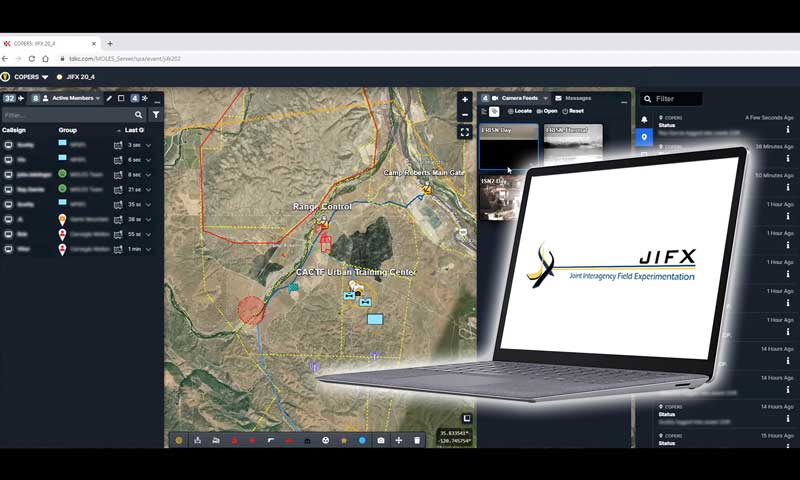
Virtual, Hybrid JIFX Continues the Collaboration on Warfighter Challenges
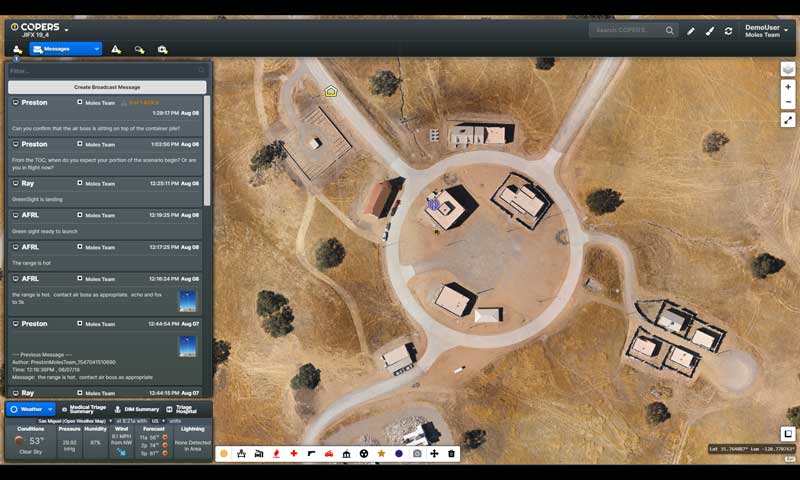
NPS, Air Force Research Lab Use JIFX to Improve Situational Awareness Tool
Naval Postgraduate School Hosts Collaborative Interagency Field Experimentation Program
JIFX In the News
From the California desert to desolate polar ice caps, the Naval Postgraduate School (NPS) continues to adapt emerging technologies to new domains.
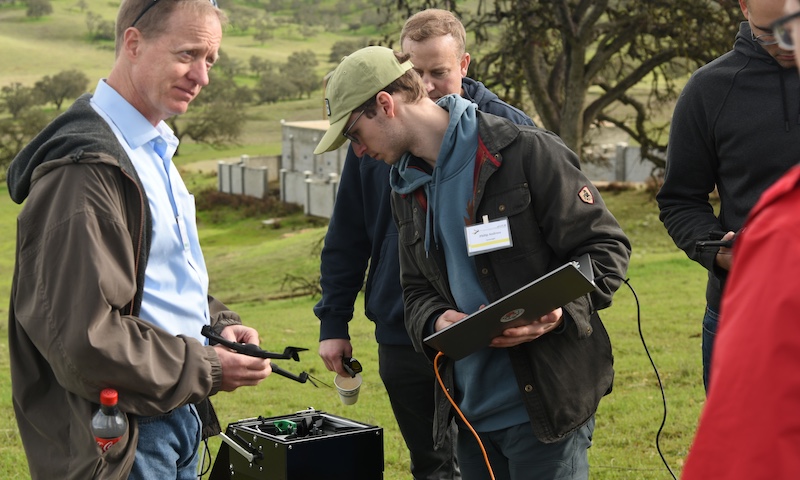
Since 2002, NPS’ quarterly Joint Interagency Field Experimentation (JIFX) program, and its predecessors, have brought together leading minds from academia, industry and the military to explore new technologies, and new ways existing technologies might prove beneficial in other applications ... often with surprising results.
“We like to think of this event as a tech-oriented ‘Burning Man’ for government,” said Dr. Ray Buettner, JIFX director and associate professor of Information Sciences at NPS. “It’s a collaborative learning environment with minimal rules where producers can get direct feedback from their consumers.”
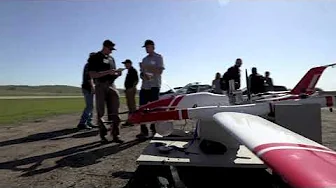
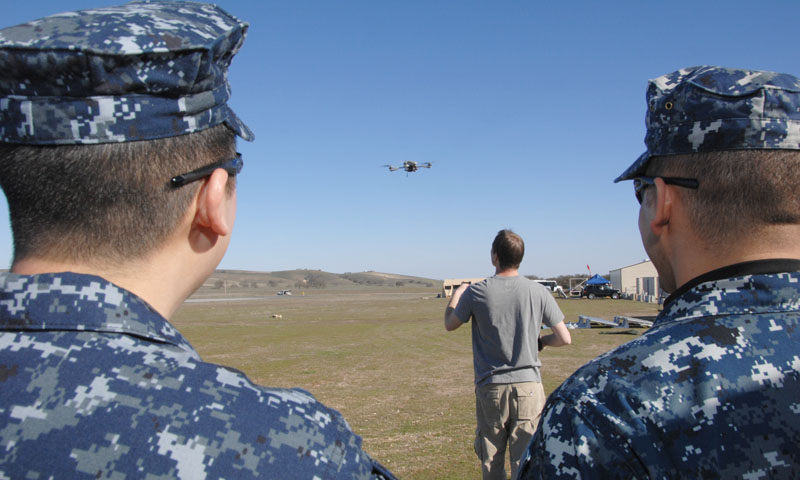
JIFX is not about acquisition, Buettner emphasized. Rather, the event offers a chance to sandbox these systems in a pseudo-operational field environment at Camp Roberts, an austere California National Guard base in central California.
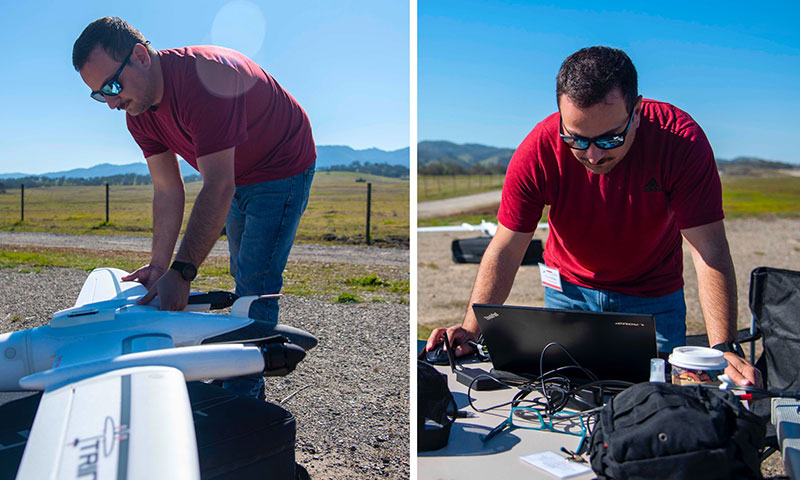
On the afternoon of June 4, the Martin UAV “V-BAT”, a state-of-the art VTOL Fixed Wing UAV, launched from McMillan Field at U.S. Army Base, Camp Roberts in a flight test to demonstrate its calculated service ceiling. Twenty-five minutes later, V-BAT descended after easily reaching the upper limit of the restricted air space and its calculated service ceiling of 15,000 feet.
After landing and a rapid payload change to an 8 lb. turret, the V-BAT was refueled and relaunched in less than an hour. The second flight was performed at a more tactical altitude and demonstrated the V-BAT’s capability of integrated flight with an Avwatch tracking antenna, successfully conducting ISR missions at ranges in excess of 50 miles.
Phillip Jones, Martin UAV’s Chief Operating Officer and former RAF fighter pilot said, “With these milestones, V-BAT has demonstrated all of the key performance parameters we set for it two years ago. The focus for the engineering team will now shift to enhancing and refining these capabilities to even better meet & exceed warfighter requirements.”
Both tests were performed as a part of the Naval Post Graduate School’s Joint Interagency Field Experiment 18-3 (JIFX), an event that provides government, industry and academic innovators the opportunity to collaborate and experiment with new technologies.
Aerial dogfighting began more than a century ago in the skies over Europe with propeller-driven fighter aircraft carried aloft on wings of fabric and wood. An event held recently in southern California could mark the beginning of a new chapter in this form of aerial combat.
In what may have been the first aerial encounter of its kind, researchers from the Georgia Tech Research Institute and Naval Postgraduate School recently pitted two swarms of autonomous aircraft against one another over a military test facility. While the friendly encounter may not have qualified as an old-fashioned dogfight, it provided the first example of a live engagement between two swarms of unmanned air vehicles (UAVs), and allowed the two teams to demonstrate different combat tactics in flight.
WhiteFox Defense Technologies, Inc. demonstrated their flagship product, the DroneFox, to a range of U.S. military leaders during the Joint Interagency Field Experimentation (JIFX) program from July 31 to August 4, 2017. The U. S. Department of Defense’s Defense Innovation Unit Experimental’s (DIUx) Rogue Squadron used the “red teaming” method to test the product’s capabilities in an operational field environment against “red” (terrorist) drones.
The DroneFox allows soldiers to focus on their missions and know that the sky above is safe from “flying IEDs.” It is the only system that allows operators to perform a threat assessment of drones while whitelisting “friendly drones.”
A jammer-hunting UAV employs a radio frequency (RF) detection system and a navigation control scheme. The RF detection component uses a directional antenna and the unmanned aerial vehicle’s (UAV’s) ability to rotate to determine a bearing to the jammer. The navigation control scheme selects a trajectory for making bearing measurements that enable rapid jammer localization, based on three bearing calculation methods: max, cross-correlation, and a modification of max leveraging the shape of the antenna’s main lobe, known as max3.
Whether malicious or unintentional, GPS jamming events have already proven to disrupt airports and pose an increased risk to commercial aviation in the future. An important mitigation for this risk is the ability to rapidly locate and interdict the GPS jamming device.
The system must be capable of reliably determining jamming direction and quickly localizing the source in the semi-urban environments typically found in and around airports. This article examines both aspects.
In developing a localization algorithm, the measurements being made by the system can greatly impact performance. Using a directional antenna as the primary sensor, our multirotor platform Jammer Acquisition with GPS Exploration & Reconnaissance (JAGER) can measure the bearing to the jammer, which is the main input into the localization algorithm. Here we examine three different bearing calculation techniques from a gain pattern: max, cross-correlation and max3.
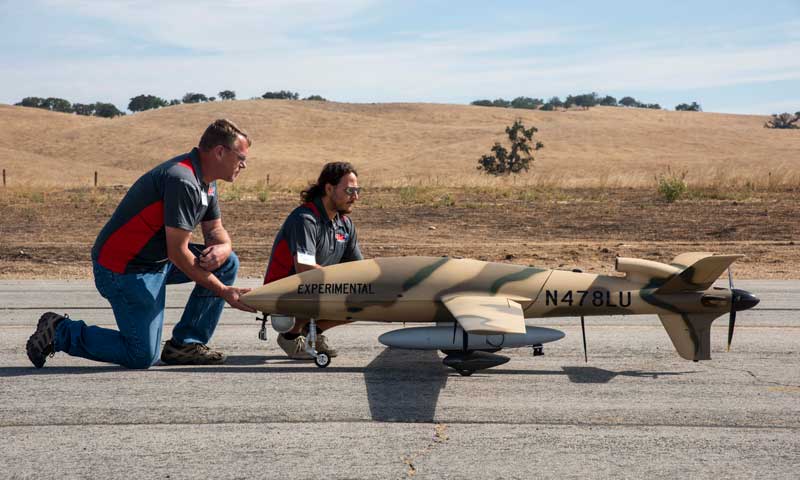
Latitude Engineering has conducted over 15 test flights of HQ-60B aircraft in the last month on two different airframes. The aircraft is the final version of the HQ-60 platform, which is designed for 12lbs of payload and > 15 hours of endurance. Two fuel injected engines are being evaluated for reliability and fuel economy during the first phase of testing and the vehicles are proving their relability and capability in high winds during fully autonomous launch and recovery.
Martin UAV LLC, a San Jose, California based designer and fabricator of unmanned aerial systems (UAS) recently participated in the 2016 Joint Interagency Field Experimentation (JIFX) event at Camp Roberts, California, at the invitation of the United States Naval Post Graduate School. The company’s flagship vertical take-off and landing (VTOL) aircraft, the “V-BAT”, conducted operational flights from a remotely confined area as well as a prepared runway at the United States Army’s test range.
The Martin V-BAT is the first aircraft of its size and capability to successfully demonstrate the ability to takeoff vertically, transition to wing-borne flight like a sail-plane, and land from a hover The V-Bat is capable of hovering over select locations along a pre-programmed flight path before returning to land vertically in a concealed and confined area. The V-BAT has achieved the critical operational benchmark of vertical take-off and landing without the assistance of any launch or recovery equipment, making it unique in the UAS marketplace today.
High impact and high visibility disasters have increasingly revealed the proliferation and widespread use of mobile devices, social media, photos, videos, and other sensory data and channels as information sources. This information can be helpful in planning for, responding to, and recovering from disasters and emergencies. The amount and speed of available information, however, in addition to a lack in ability to identify, verify, aggregate, coordinate, and contextualize information gleaned from social media, leaves data often unused and un-actionable.
To address technology gaps across a variety of disciplines, including information sharing, the U.S. Department of Homeland Security Science and Technology Directorate, in partnership with the Office of the Secretary of Defense and the Naval Postgraduate School, hosts the Joint Interagency Field Exploration (JIFX). Each quarter, JIFX participants utilize different methods of interaction, all of which focus on end user input, which reflects and address the most complex challenges identified by those directly engaged in homeland defense and security. JIFX 2014-2, held at Camp Roberts, Ca., February 10-13, offered participants an opportunity to participate in an experiment looking at the usefulness of social media and data to address agency mission objectives and pre-existing information requirements to achieve enhanced situational awareness and decision support.