Systems Engineering Masters Program, MSSE (580)
MSSE Program Accreditation
The MSSE Program is accredited by the Engineering Accreditation Commission of ABET.
Accredited programs must have published Program Educational Objectives and Student Outcomes, a process for periodic review of the objectives and outcomes, and a system of ongoing assessment that demonstrates achievement of the objectives and outcomes and uses the results to improve the effectiveness of the program.
The Masters in Systems Engineering (MSSE) program is an ABET accredited program primarily serving the Navy Engineering Duty Officer (EDO) community.
Admission Requirements
An ABET EAC accredited Bachelor of Science degree in an engineering discipline or established equivalency,
Overall GPA of at least 2.60, and course grades of C+ or better in both a complete calculus sequence and a complete calculus-based physics sequence. Additional courses in matematics, physical sciences and engineering are highly desirable.
Entry Dates: September and March
Program Officer: CDR Caleb MacDonald
Academic Officer: Mark Stevens
MSSE Degree Requirements:
-
36 hours of graduate level courses, with at least 16 at the 4000 level.
-
Completion of Systems Engineering Core course sequences and completion of a thesis. The thesis is equivalent to at least 12 credit hours.
-
{Note: ESR and p-code requirements for Navy students on the Combat Systems track generate additional requirements covered by the other courses in the matrix.}
Student Outcomes
In order to achieve the program educational objectives for the Master of Science in systems engineering (MSSE) program, graduates must complete at least one year of study, or at least 45 quarter credit hours, beyond a baccalaureate level program, achieve a mastery of systems engineering, and complete a thesis or capstone project report, where each student attains outcomes demonstrating competency in:
- Advanced mathematics, including probability and statistics, and computing
fundamentals, with practical applications thereof.
- Engineering topics necessary to define, synthesize, analyze, design, and evaluate complex systems containing hardware and software, and human elements (where appropriate), in a holistic manner across the lifecycle.
- Systems design and analysis topics, such as decision analysis, risk analysis (cost, schedule and performance), trade-off analysis, optimization, modeling based engineering, simulation, sensitivity analysis techniques, or requirements
engineering.
- Communication: Communicate effectively both orally and in writing.
In addition to attaining these student outcomes, each student will have had post-secondary educational and/or professional experiences that supports that attainment of student outcomes as defined in the ABET EAC general criteria for baccalaureate programs, Criterion 3; and includes at least one year of math and basic science, at least one-and-a-half years of engineering topics, and a major design experience that meets the requirements in the general criteria for baccalaureate programs, Criterion 5. Students that have attained an ABET EAC accredited undergraduate degree meet these post-secondary requirements.
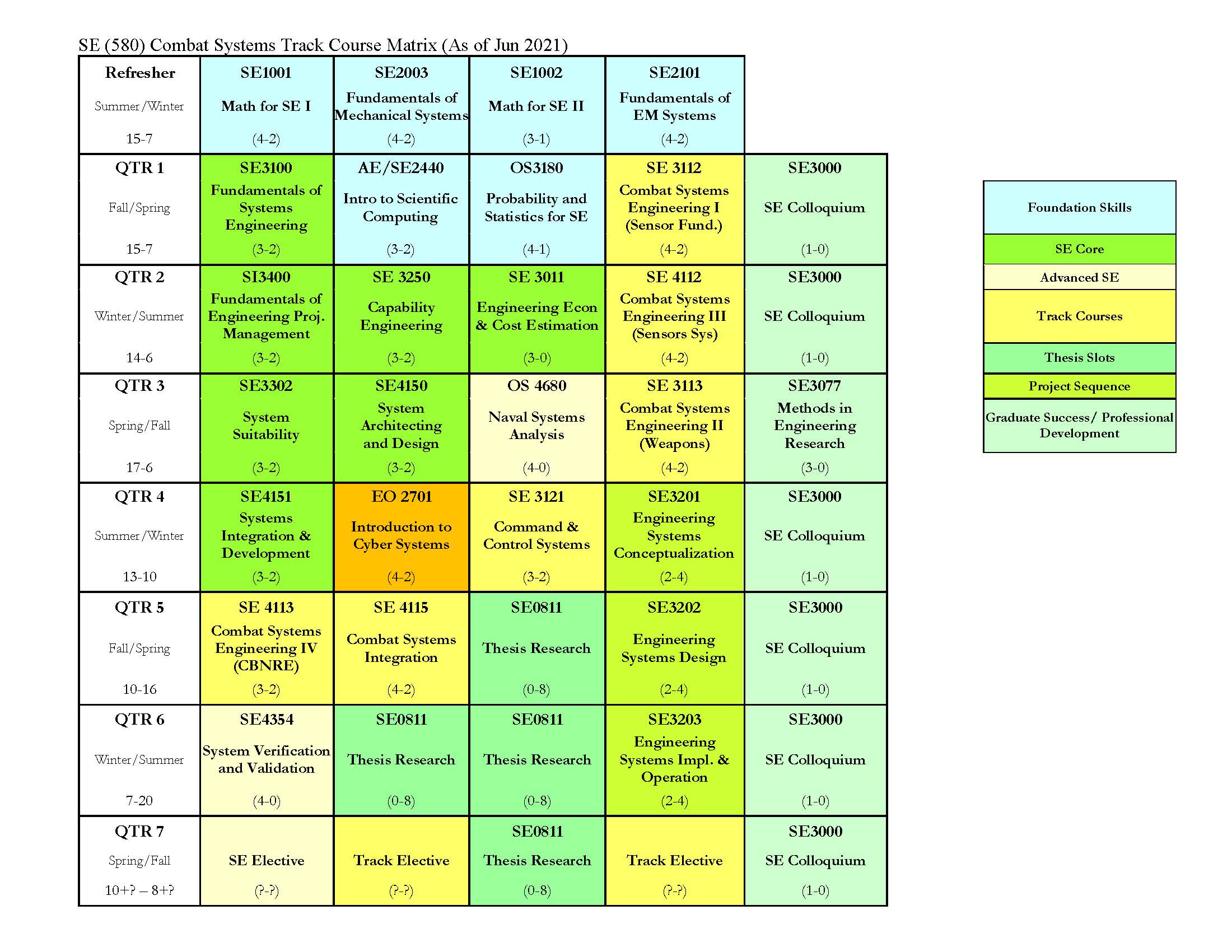
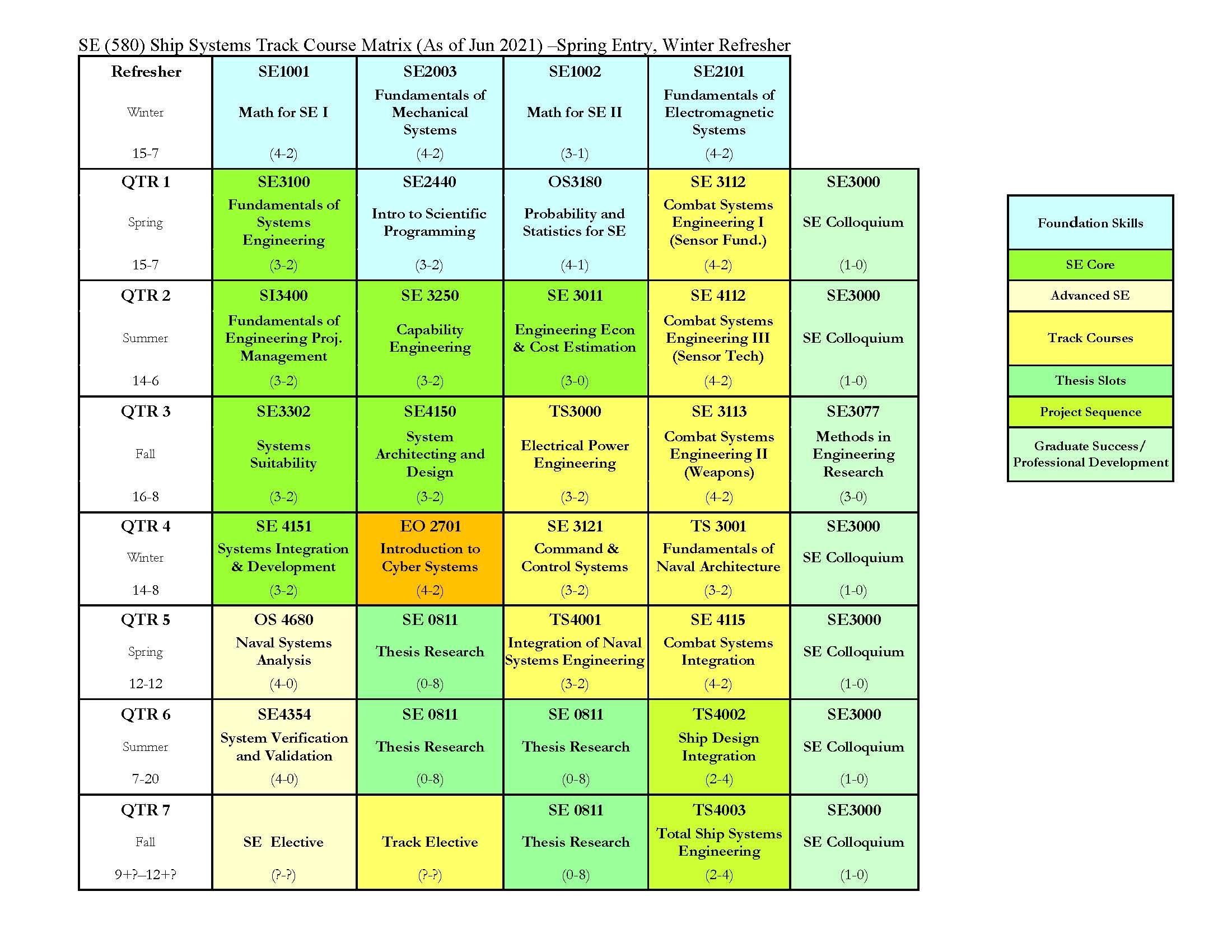
MSSE (580) Program Tracks
- Combat Systems
- Matrix A - Track is the same regardless of program entry date
- Ship Systems
SE or Track Electives include courses such as:
- SE4003 Systems Software Engineering
- SE4353 Risk Analysis & Management for Engineering Systems
- SE4520 Systems Manufacturing Development and Production
- OA3401 Human Factors in System Design
- OA3411 Introduction to Human Systems Integration
- ME4751 Combat Survivability, Reliability and Systems Safety Engineering